

The first post in this series looked at starter batteries from the driver's seat. This one looks at them from the other side of the counter — from the dealer's shelf and the repair shop's workshop. A dealer or a repair shop does not buy chemistry either. They buy a product that is cheap to store, quick to handle, and does not die on the shelf. Here is how sodium-ion compares with lead-acid on the costs a dealer or a repair shop actually feels, using our H5–H9 spec sheets against typical lead-acid practice.
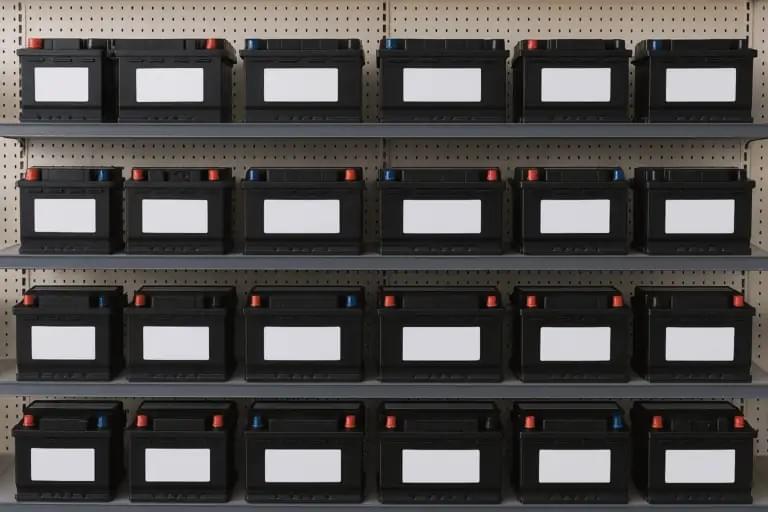
Every battery gets lifted several times: off the truck, onto the shelf, off the shelf, into the customer's car. A lead-acid starter battery weighs roughly two to three times as much as the sodium-ion unit that replaces it. Our range runs 5.5 kg (H5) to 11 kg (H9) — 35–40% of an equivalent lead-acid battery.
At that weight, one person can carry it without a second pair of hands or a trolley, and each move takes less time. Over a day of deliveries and installations, the minutes add up — and so does the strain you take off your staff.
2. Shelf maintenance: a top-up every six months, not every two
A battery on the shelf slowly discharges, and a discharged lead-acid battery sulfates — left too long, it is dead stock. So lead-acid inventory needs a top-up charge every two to three months, every unit, on a schedule someone has to run.
Our sodium-ion range needs a top-up only every six months. That is half the charging rounds a year: less bench time, less labor, and fewer batteries written off because a round was missed. The difference is not the discharge rate — sodium-ion still self-discharges (≤3.5% a month), so it still needs attention. The difference is what happens while the battery sits discharged: lead-acid sulfates and loses capacity permanently, while sodium-ion does not. It just needs that attention half as often.
3. No liquid to top up
Flooded lead-acid needs its electrolyte level checked and topped up with distilled water — a maintenance round for every unit on the shelf, plus distilled water to stock and acid to handle. The sodium-ion range is sealed: no liquid to check, no water to add, nothing to spill on the floor or on a technician's hands. One maintenance task simply disappears from the shelf routine.
4. Store it any way up
A flooded lead-acid battery must stay upright. Lay it on its side and acid leaks out. That constrains how you shelve it, how you pack it, and how you load a truck. The sodium-ion range is sealed, so orientation does not matter: it can be stored and transported on its side, which makes shelving, packing, and loading simpler.
5. Stack it higher
Lead-acid is heavy, and its cases carry the load — so stacking height is limited, and each unit takes more shelf and floor space. At a third of the weight, sodium-ion stacks higher, so you fit more units per square foot of warehouse. For a dealer or a repair shop paying for floor space, that is real money.
The bottom line for dealers
Less lifting, half the charging rounds, no liquid top-ups, storage in any orientation, and more units per square foot — that is what sodium-ion saves on the shelf. And it is the same battery your customers already want: it cranks at −40°C, carries a 36-month warranty, and needs no maintenance from the driver. The trade-off is the same as for drivers — it costs more upfront. But on the shelf, it costs less to keep.
NaExpress supplies the H5–H9 sodium-ion starter range in Canada, from 600A to 1,000A CCA. If you sell or install starter batteries:
📞 Sales Hotline: 1-437-362-7652
🛒 Contact us
