

On September 9, 2026, more than 140,000 home batteries across California — about 110,000 of them Tesla Powerwalls — discharged a record 580 megawatts to the grid during a heat wave. It was the largest residential virtual power plant (VPP) event ever recorded: thousands of small batteries in people's garages, coordinated by software, doing the job of a conventional power plant. Canada's grid faces the same pressures that made this possible — and sodium-ion batteries, built for cold climates and long cycle life, are a natural fit for the VPP era.
What happened in California on September 9?
During an evening heat wave, air-conditioning load pushed California's grid to its limits. Instead of firing up fossil-fuel peaker plants, two existing state programs called on home batteries:
- The Demand Side Grid Support (DSGS) program triggered automatically once day-ahead electricity prices crossed $200 per megawatt-hour.
- Utilities directly called an Emergency Load Reduction Program (ELRP) event as the heat wave peaked.
The result, reported by Electrek: 580 MW delivered over a three-hour evening window from 140,000+ home batteries — roughly 110,000 Tesla Powerwalls delivering 517 MW, plus 30,000+ batteries from other manufacturers in Sunrun's fleet adding 63 MW. That's enough to power every household in Sacramento County during peak hours. The next evening, another 140+ MW was dispatched at Southern California Edison's request.
Tesla Energy confirmed the scale itself on X: at the peak, roughly 69,000 Powerwall owners were dispatching more than 500 MW to the grid — "equivalent to the output of a power plant, but from Powerwalls already in people's homes."
This didn't come from nowhere. Tesla's California VPP has grown from early pilots of a few thousand homes to a network of 105,000+ homes, and Tesla paid Powerwall owners nearly $10 million for VPP participation in 2024 alone.
What exactly is a virtual power plant?
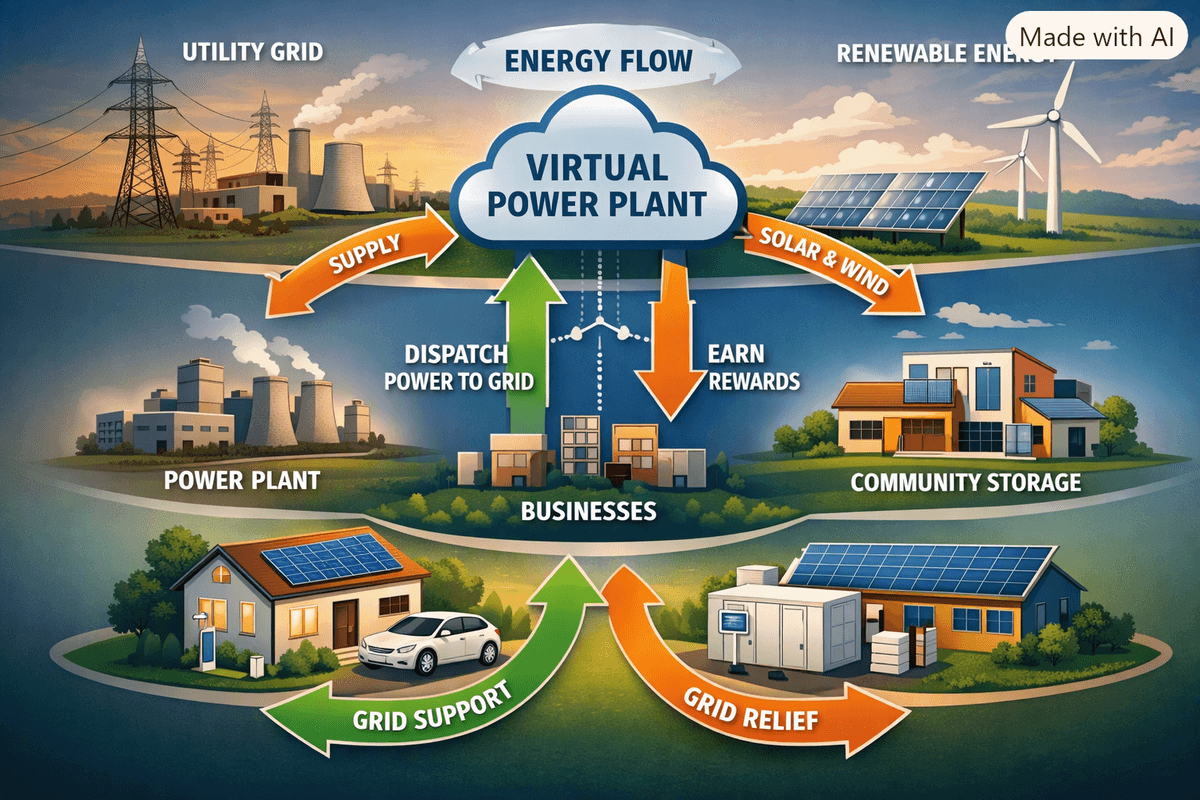
A virtual power plant has no smokestack and no land of its own. It's software that stitches together thousands of distributed batteries — in homes, businesses, and soon vehicles — so grid operators can tap their stored electricity exactly when the grid is stressed.
The economics are what make it spread: instead of spending years and billions building a peaker plant that runs a few dozen hours a year, a VPP can be assembled in months from batteries people already own. Homeowners charge cheap (overnight, or from their own solar) and get paid when their battery discharges during grid events. The grid gets clean, instant peaking capacity exactly where it's needed — no new transmission lines required.
California's heat waves are dramatic, but Canada's grid faces the same structural pressures:
- Electrification and AI data centers are driving the fastest electricity demand growth in decades on both sides of the border.
- Extreme weather stresses the grid here too — ours just comes as winter cold snaps instead of heat waves. A January polar vortex peak is Canada's version of California's September air-conditioning peak.
- Time-of-use pricing already exists in Ontario: off-peak, mid-peak, and on-peak rates mean a home battery can charge cheap overnight and discharge during expensive evening peaks — real bill savings today, even before any formal VPP program pays you a cent.
Canada's grid operators already run demand-response programs. The California playbook — pay distributed batteries for grid services through structured programs like DSGS and ELRP — is entirely transferable. The missing piece isn't technology. It's the market framework. And frameworks follow proven results: 580 MW is a result that's hard to ignore.
Why sodium-ion batteries are built for the VPP era
Here's where chemistry matters. A VPP battery isn't a backup battery that sits idle for years — it cycles frequently, sometimes daily. That punishes chemistries with short cycle lives and rewards three things sodium-ion delivers:
- Cycle life. VPP economics are earned one cycle at a time. Sodium-ion cells are rated for thousands of deep cycles (1,500–6,000 depending on chemistry and conditions), so a battery enrolled in grid services doesn't wear out its warranty earning its keep.
- Cold-weather performance. This is Canada's decisive advantage. Conventional lithium-ion capacity falls off hard below freezing — exactly when a Canadian VPP would be called on most. Sodium-ion chemistry retains far more of its capacity in sub-zero temperatures, which is why it's engineered for markets like ours. A VPP made of batteries that fade in January is a VPP that fails when needed.
- Abundant materials, scalable cost. Sodium is everywhere; lithium, cobalt, and nickel are not. As VPPs scale from thousands to hundreds of thousands of homes, cost per kilowatt-hour decides how fast the fleet grows. Sodium-ion's material economics point in the right direction.
None of this requires new inventions. The building blocks already exist: home systems from 2.4–12 kWh that sit in a garage or basement, and commercial systems from 120–500 kWh that can anchor a neighborhood-scale node. A VPP is, at its core, an aggregation business — and every aggregation starts with one installed battery.
What would a Canadian VPP look like?
Imagine an Ontario suburb: 1,000 homes, each with a 10 kWh battery. That's 10 MWh of dispatchable capacity — a small peaker plant, distributed across rooftops and garages, invisible until the grid calls.
On a normal day, those batteries do quiet time-of-use arbitrage: charge at 2 a.m., discharge at 6 p.m., shaving the homeowner's bill. On a −25°C January evening when the province hits its winter peak, the grid operator calls a VPP event, and those same batteries discharge together — keeping the lights on without firing up a gas peaker.
Pair that with vehicle-to-home technology maturing alongside it, and the "power plant" gets bigger every year without pouring a single foundation. The question for Canada isn't whether this works — California just answered that with 580 MW. The question is who builds the framework first, and which battery chemistry it's built on.
Sources:
- Electrek — Tesla and Sunrun's virtual power plant dispatch record 580 MW to California grid
- TeslaNorth — Tesla Powerwalls Dispatch Over 500 MW in California Heatwave
- Drive Tesla Canada — Tesla Powerwalls Send 500 MW to California Grid During Heatwave
- Canary Media — Tesla offers discounted home batteries in New England (VPP program)
- Canary Media — California's latest virtual power plant record
